Divorce

Growing up, marriage terrified me. Losing loved ones created a fear in my heart. I thought marriage wouldn’t be for me because what if the man I married decided he didn’t want to be with me anymore? What if something were to happen that resulted in divorce to be the answer? I thought being single would be better than getting married and potentially having my heart broken down the road if that ever were to happen. Obviously, the statistic of knowing 50% of marriages ending in divorce did not help but made it worst so I built up walls and prepared for a life of singleness.

For all who believe the divorce rate is 50%  in the United States, you are not alone. However, that number is not accurate. The divorce rate is closer to 30%. While that is a better percentage, if you are a person who places your focus on these numbers, remember that number does not define you or the relationship you are in. If two individuals fall so madly in love with each other and take the step to commit forever, why resort to divorce years down the road? What is divorce and what causes divorce?

I always thought divorce was a separation where the couple is no longer under a legal obligation to be together. Did you know there is more to divorce than just that? There are six types of divorce’s: 

1.    Emotional Divorce: disconnection of emotions

2.    Legal Divorce: legalize divorce

3.    Economic Divorce: dividing of materials

4.    Co-Parental Divorce: splitting of the children

5.    Community Divorce: splitting up of friends, picking who to stay friends with

6.    Psychic Divorce: excepting divorce mentally

Several years ago, there were four reasons a couple could divorce in court and they are known as the four A’s; Abuse, Adultery, Addiction, and Abandonment. If a couple had evidence of one or more of the four A’s, the divorce was granted. That has changed. Today, divorce is as easy as getting married and couples can divorce for any reason they choose. While the reasons for divorce have broadened, it can be expensive. Divorce on average can cost as much as $125,000. Wowzah! With the expense and time of getting a divorce, research shows that 70% of couples who divorced regretted it about two years after the divorce was finalized.

I believe that if there is abuse in your relationship, seek help. It is unacceptable to be abused physically, emotionally, and verbally. With that being said, when stress puts a strain in your life, draw closer to your spouse rather than apart. In the time I have been married, I have come to the realization that marriage is not hard but life. The stresses of life such as not having enough money, loss of a job, school and other debts, loss of a family member or friend, and more can make us sad, angry, and rather than talking about it with our spouse, we become short and impatient with them. When something negative happens, why is it that we tend to jump to ask ourselves, “Did I marry the wrong person? Did I get married too early?” and other similar questions? Doing these things is natural. When times get hard, giving up is natural.

Over time, I decided to not allow my fears choose what I would do with my life. When I met my husband, I knew I could trust him and with time, the walls I built crumbled to the point where I was open to marriage and welcomed it with joy. Instead of doing what is natural, I did the supernatural and got married despite my fears. Let us do the supernatural. Do not quit when things get hard. Work out the troubles and strengthen your love with your spouse. The time you put into thinking about divorce, wondering if you are falling out of love, and other negative thoughts, replace them with positive thoughts. Studies prove that couples who decide to work on their marriage report they are happier and satisfied with their marriage. No one is perfect. We all have shortcomings and should not judge our spouse wrongfully. Marriage, like other things, takes time and work.  Create a strong bond, let your love grow, and save your marriage and family.
The Needs of A Child

Being human, we all have needs. Those needs are food, water, sleep, and a roof over our heads. These needs help all of us, children and adults, function to our fullest capacity. However, children have other needs that need to be recognized and approached by parents. What are these other needs?

The first is contact and belonging. We all want to feel like we belong at any age but children especially in certain times of growing up need to know they belong, are loved because they yearn the contact of their parents in the form of a hug or time spent with them. Children think the way they can belong is by seeking for attention but this is a mistake and can be dangerous. Parents should offer contact and time freely and constantly while teaching children to contribute to everyday activities.

The second need is power. No one wants to feel week or inferior and this just may be how some children feel when they face a bully at school or are mistreated by loved ones. Children often will rebel because, in order to have power, they feel they have the need to control others. Parents should teach children responsibility by giving them chores and consequences. It is important to remember that consequences should not be in the form of rewards and punishments. This only leads the child to feel bitter, entitled, and takes away from the child making decisions on his/her own. Allow the child to learn from natural consequences as long as it is not dangerous or harmful to others.

The third need is protection. No one wants to feel like they are not safe. A child may mistakenly approach their need for protection through revenge but that is not right. Parents should teach children assertiveness and forgiveness. How do parents teach assertiveness and forgiveness? By action. Children will learn through example and when they are provided opportunities to grow.

The fourth need is to withdraw. This is the good kind of withdraw because it just means having a need to take a break from something. We all need to take a break when we are doing a task that is hard or long. Children approach it wrong because when they take a break they do not return to the task. Now, I am sure it is not only children who do that. I don’t always return to the task. Sometimes I find it hard to concentrate when I have to write an essay for class so I decide to take a break and watch an episode but somehow an episode usually returns into five and before I know it I have forgotten the essay. It is important and critical to teach the importance of finishing a task started from an early age so that the habit of procrastination is not built.

The last need I will mention is challenge. As adults and parents, it is easy to be overprotective of children. Children need to face challenges and as adults and parents to teach and encourage them to learn skills and master them. If children do not have these then when they do face a challenge they will quit or take the easy way out.

I myself am not a parent but from my own experience growing up, I believe some of the most important things parents can do for their children is to be patient with them, allow them to make mistakes and to make their own decisions. When children are not given the opportunity to make choices, they feel like they cannot be trusted and this could lead to distance from the parents. As adults and parents, we need to remember that we too were their age once and did similar if not the same things. Be patient, love your children and help them live to their fullest potential.

Fatherhood

In a song I heard not too long ago stated what a father is or should be. It words went like,
“A father’s place is to preside, provide,
To love and teach the gospel to his children.
A father leads in family prayer to share
Their love for Father in Heaven.”
The Family: A Proclamation To The World backs up the song’s lyrics by stating, “By divine design, fathers are to preside over their families in love and righteousness and are responsible to provide the necessities of life and protection for their families. Did you catch that? Both the song and the proclamation state a father’s role with three P’s; preside, provide, and protect.

To Preside
A father presiding means to teach his children and care for them. A father should exercise righteous influence as he uplifts his children. A father is there to counsel his children and bless them in life. Fathers who are involved in their children’s lives leads to greater cognitive ability, less behavioral issues, have sons impregnate girls at a young age or daughters who get pregnant at a young age, decrease the chance of getting into drugs, increase the chance of having successful relationships, and achieve higher education. Fathers who are involved have children who have fewer problems in school and have higher social competence.

To Provide
While things may have changed, for a long time fathers were the only provider in the home unless the mother had to get work to help financially. A father’s primary responsibility is to provide for his children’s necessities of life such as clothes, shelter, and food. “To be a good father is often equated with being a good provider. This context of material demands and management of resources in raising a family furnishes another fundamental principle of fathering, which it to meet a child’s temporal needs and make opportunities for him or her to grow and develop” (Hawkins, Dollahite, & Draper 2012, p. 145).

To Protect
Life is not easy. It is full of stress, confusion, and threats. When children come into the world, fathers should prepare children for the challenges of life. A father is a protective figure in the home and as he prepares his children and teaches them skills to survive and make their own choices in life when they leave the home. As a protector, it is important to monitor the environment your children are in. “most fundamentally, a father’s presence and protective attention in the home environment tend to limit the intrusion of other negative influences that can affect children, such as gang culture or criminal invitations” (Hawkins, Dollahite, & Draper 2012, p. 147).

Some fathers are involved while others are not but the point is, everyone has different experiences with their father. My father worked at home so I had the chance to see him 24/7. While he was around, it wasn’t as if I was chillin’ with my dad because he had work to do as he was providing for the family. However much my father worked, he was at the dinner table and played games with us children before bed. Every Saturday when the weather was good, my father would be outside doing yard work and spending quality time with the family. My father taught us the value of hard work, make confident choices, honesty, and responsibility.

My husband and I do not have children but we have many conversations about what kind of parents, a father and mother we would like to be one day. We both had fathers who were involved as we were growing up and built strong bonds with us. Something we do currently to ensure father involvement in our home is to set time away from the business of life and spend that time together where we are away from distractions like our phones. Once a week we have a date planned where we do something we have not done before and plan a weekend trip once a month where we visit somewhere close to where we live. Being involved now in each other’s lives and taking ourselves away from distractions will get us in the habit early so when we have children, we will be involved in their lives and to be the parent who is a leader, teacher, and friend.

Reference:

Hawkins, A. J., Dollahite, D. C., & Draper, T. (2012). Successful marriages and families: Proclamation principles and research perspectives. Provo, UT: BYU Studies and School of Family Life, Brigham Young University.

Communication is Key

When my husband and I got engaged, the most repetitive advice we received from many married couples was “communication is key.” Communication is and can be tough when putting two people together because communication means something different to each individual as each individual has different expectations. As technology continues to grow, our social cues are becoming more ambiguous in our day. We have smartphones now that don’t require us to communicate with each other directly because we are able to text without having to show emotion or think too hard about our responses.

Communication includes words, tone, and non-verbal (actions). How often do we use the three when communicating? We use about 14% words, 35% tone, and 51% non-verbal. When we use texting to communicate, we are only using words. When we speak over the phone, we use words and tone. With texting, we are not able to use tone so we plug in emoji’s to replace tone.

Communication at times is not the best between my husband and me so if you have a hard time communicating with your significant other, I hope applying what I share will help. David D. Burns, MD, came up with The Five Secrets of Effective Communication also known as EAR meaning Empathy, Assertiveness, and Respect.

Empathy is the ability to listen and relate to other people. When an individual has empathy, he/she except other people rather than attempt to change them. When expressing empathy, there is thought empathy and feeling empathy. Thought empathy is being able to paraphrase other words. Feeling empathy is being able to understand others emotions and acknowledge their feelings. As you express empathy, ask gentle questions to learn more about what others are thinking and feeling.

Assertiveness is being specific when expressing your feelings. It is important to be tactful, using low-key, dignified language. When communicating your feelings use these steps:

  • When: event/situation
  • I feel/I felt: show and verbalize emotion NOT judgment
  • Because: thoughts
  • I would like: share hope

This past weekend, I was upset with my husband for not wanting to help me fold laundry even though he had promised me he would help. Now keep in mind I was asking him to fold laundry at midnight and he was tired but instead of looking at the facts that it was late and he was tired, I was upset he was not following through with his promise and I said some words that I now regret. If I had inserted assertiveness into our conversation, this is how it would look…
“When you didn’t want to help me fold laundry, I felt hurt because I thought you would be supportive of me asking because you know I feel stressed with having a messy living environment. I would like it if you would fulfill the promises you make.”

The last step is Respect. It is important to have an attitude of respect and to intentionally go out of your way to express authentic and genuine admiration or appreciation when communicating with others. It is so easy and natural to focus more on the negatives rather than the positives of ourselves and our significant others. But to have good communication, we must strive to get past feelings of frustration and not only tell but show that we do love and appreciate them. Something my husband and I love to do to show appreciation for one another is something we call “warm fuzzies.” Since the day we got married, every night we tell each other a warm fuzzy or something positive we saw in one another that day. This helps us focus on the positive and look at the good in each other so there is no room to look for and focus only on the negatives and imperfections we have.

How is your communication with you and your loved one(s)? if you haven’t tried the EAR method, I invite you to apply it and see how it may change your communication when difficulties or disagreements arise with your significant other, family, and friends.

You can find The Five Secrets of Effective Communication here
https://feelinggood.com/2016/12/12/014-the-five-secrets-of-effective-communication-part-1/

Family Stress

The dictionary states that stress is any persistent worry and/or fear about everyday situations we face. Many of us wish and dream of a stress free life. Did you know that we actually need stress in our lives and relationships?? While we see stress through negative lenses, stress actually strengthens us individually and brings us closer to our spouses, children, family members, and friends. Here are a few of the many family stressors we may face and are currently facing:

  • Money
  • Disabilities
  • Depression/Anxiety
  • Religion
  • Death
  • Infidelity
  • Infertility

Everyone acts differently to these stress factors. For example, when I face stress individually or in my marriage I tend to panic, cry, try to run away from it, or push it away. My reaction does not serve me well because stress does not just leave; it stays. My husband on the other hand faces stress head on. While it may worry him, he does not panic but stands strong and deals with it. As we are merely human, we only do as what comes natural! The way we might react when facing stress or the way we make mistakes in life does not make us a bad people for we are only doing what is natural.

Let’s talk about one of the family stressors from the list. Depression. When an individual has depression, it not only affects them but also those around them. For example, research shows that children from depressed homes that are adopted into undepressed homes are not depressed while children from undepressed homes are adopted into depressed homes become depressed. Why is this the case? Because depression is not genetic but a social behavior that we pick up. When facing depression and other family stressors, we ask ourselves questions like, why me? Why my family? Why is my spouse or children acting this way? When we face any crisis, we drown ourselves in “what if.” We chew ourselves out, put ourselves down and condemn ourselves when we make a mistake or quit when something becomes too hard for us to accomplish.

How families define problems is how we communicate with each other. Instead of coming together, we grow apart. We turn inward. Internal is worse than external because internal draws us further from our loved ones whereas external helps us come closer to each other. Rather we should recognize we made a mistake, learn from it then turn around and not do it again. We should recognize that it is ok for something to be hard and work even harder to accomplish the task. We must do our hardest to recognize our own untruth thoughts and replace them with true thoughts! The beauty of everything is that we get to choose! We get to choose what we think and say. We get to choose how we react. Our brain is fixated on what we tell it because the brain is a judging machine and assesses what we see. There are many stresses in life and we will face stress endlessly. What is the best thing to do when facing stress? Take control and handle things as they are. This may be easier said than done but remember that all things are possible.

Intimacy in Marriage

Sex. There are couples who shy away from talking about sex or even saying the word. Sex is not a dirty word. It is ok to say the word and to talk about it, especially with our spouses. Sex or intimacy is supposed to be beautiful and sacred. Within a marriage, couples may avoid this topic but avoiding it only causes problems. Did you know that sexual problems are one of the causes of divorce within the first couple of years of marriage? Once married, it is not only important to cleave unto one another, as the Bible states, but when sexual needs are not being met, to also communicate about our sexual desires and satisfaction.

What happens when there is no open communication about intimacy? Studies show that individuals turn to other materials whether it be in the form of music, literature, TV, or pornography because it is readily available and helps relieve negative feelings while helping them feel satisfied momentarily. While this may help the individual momentarily, it creates unrealistic expectations from one’s self and their partner that will cause additional problems and conflict in the marriage. Conflict about sexual practices will put a drain on the marriage which can lead to separation and eventually divorce.

Currently, I am reading Successful Marriages and Families. One chapter puts its focus on marital sexuality and fertility and provides five “attitudes that help promote positive marital sexuality:

  1. Sexual interaction is a healthy component of marriage that need not be a source of negative feelings or guilt.
  2. Married persons deserve to feel good about their bodies and to view sexual expression as a normal, healthy part of their marriage.
  3. A primary component of marital sexuality is giving and receiving pleasure-oriented touching in the context of an intimate, committed, and divinely supported relationship. As such, it requires relaxation and focus on the other person as well as on one’s own pleasure.
  4. Sexuality should be expressed in a way that enhances your intimate, marital relationship and bonds you together.
  5. Couples should strive to create a “we” relationship, where both partners’ sharing and pleasure is important as opposed to one person individually focused on what she or he will get out of the experience. (Hawkins, Dollahite, & Draper 2012, p. 52)”

Growing up, my parents gave me the bird’s and bee’s talk once then it was never brought up again. I am sure if I wanted to talk about it my parents would have obliged. However, I felt uncomfortable asking them because sex was not a word spoken in the home. I felt like it was a bad thing until I was married and once married it was only to make children. Yes, intimacy does play a part in creating children and increasing family size but that is not all intimacy is about it. God created and gave us intimacy so couples can become one and strengthen the bonds of marriage both in the emotional and spiritual aspect.

In the same chapter, a teenage girl asked her mother if sex is better than candy. The mother’s response, in my opinion, expressed much truth. The mother replied, “Oh yes, dear, with your husband in an eternal marriage, sex is far better than candy” (Hawkins, Dollahite, & Draper 2012, p. 49). The truth in the mother’s response teaches that in the right context, sex brings joy and this is why it is important to cleave unto each other and not turn to other people or materials when there is a storm with intimacy. Remember, there is sunshine after a storm. With communication, time, and experience, the bedroom will become a happy place where each other’s intimacy needs and satisfaction will and can be met.

Reference:

Hawkins, A. J., Dollahite, D. C., & Draper, T. (2012). Successful marriages and families: Proclamation principles and research perspectives. Provo, UT: BYU Studies and School of Family Life, Brigham Young University.

Marital Transition

In the last entry, I talked about the importance of dating and the steps that follow like courtship, engagement, and marriage. In class this week we made a list of reasons NOT to do these steps.

Good reasons NOT to date too many people:

  • Hard to settle
  • Too much effort
  • It is burdensome
  • Already satisfied with you know of the people already dated
  • Negative feedback from society or peers
  • More time to focus on career and education
  • A lot of money

Good reasons NOT to court:

  • Commitment
  • Close off other options
  • Feel young or not ready
  • Fear
  • Time and money
  • Emotionally draining

Good reasons NOT to propose:

  • Fear of rejection
  • Fear of debt
  • Family influence

Like these steps, everything else in life also has reasons to not do it such as the career of our dreams or getting a higher education. Having a list of cons does not mean we should not make an effort to do it. If one’s goal is marriage, it is important to fulfill each step to build a foundation in the relationship. The more we date, the more we understand how to be a better partner because there is always room for improvement. This does not mean everyone has to date a lot of people because we are all different we must do what is best for ourselves. For example, my sister married her first boyfriend whereas I dated a few men and when I met my husband we dated for almost a year before committing to marriage. In each case, my sister and I felt we had found our one and felt prepared to have full-time obligations before committing to marriage.

In any relationship, more so in marriage, there are transitions.

Marital Transitions:

  • Children
  • Being with someone 24/7
  • Work
  • Finance
  • Mutual decision making
  • Living circumstances change

Many of us are not prepared for the changes that come with marriage. We each have individual living circumstances that we are accustomed to. After marriage, adapting to another individual who has their own living circumstances can be tough. One thing my husband and I had to compromise on was organization. I have OCD so I am a clean freak. My husband on the other is not a clean freak. While he is organized, he believes, “If I am living here, I want to it to look like I’m living here,” and allows things to get out of order in the home while I clean everything such as organize the pillows every time I get up or put the blankets away when I get off the couch, EVEN if I am not done using them. Weird, right?! For me, having a mess or items being out of their place gives me anxiety! After a couple of months, we sat down and discussed our differences and compromised on how to better our living situation. We agreed that I would stop cleaning everything every chance I had and he agreed to be more organized so I didn’t lose my mind. Now our apartment is now clean and organized but looks like it is lived in and feels like home.

From friends and family members I have seen that transitions can either make or break a marriage. With my marriage, I have learned the important thing to remember is that healthy relationships experience transitions. Transitions help the relationship grow and keep it alive. My advice? Don’t go into transitions blindly if you can help it. Prepare yourself. When you are prepared, you will be able to handle new things that come your way and the stress that comes from transition will be lower. At the end of the day, remember that no person is perfect. No marriage is perfect. Having a vision and communication in your relationship is key to be successful when you face transitions in your marriage.

Dating

Dating is a concept most of us if not all understand. Dating is when two people go out for food and some kind of activity. Many people do selective dating when we should be dating a wide variety of people doing a variety of activities. However, dating has changed over time and is disappearing in our culture. Today, it has become very common to date less and to hang out and/or hook up more.  A research team described dating as “sex without strings, relationships without rings.” Why are young adults today less inclined to date or marry early? A few reasons are because they enjoy the single life and want to enjoy it as long as possible, fear of commitment, too many changes and compromises, and last but not least they are able to “hook up” or have sexual relations with nothing further expected of the relationship. Dating helps us learn more about the opposite sex and ourselves. Dating also helps us learn how to trust others, how to work well and interact with others (particularly the opposite sex), and develop new skills and/or improve already acquired skills.

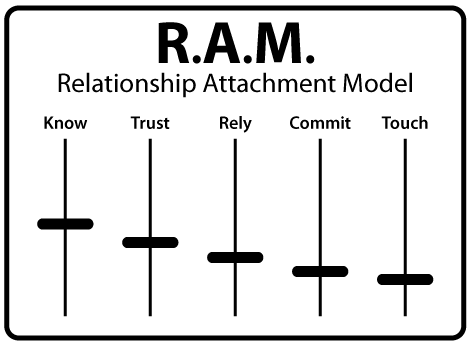
While dating, we look for and find qualities that we are attracted to. The first quality men and woman look for is physical attractiveness. There is nothing wrong with physical attractiveness to be first because it is necessary for one to be attracted to the other person. With that being said, it is important to understand there is more to a person than their looks. Other qualities to look for can include forgiving of others, understanding, have a desire to have a family if that is your desire, compatible, and have the same religious beliefs. Attraction is not enough when dating with the end goal of marriage. That is where the Relationship Attachment Model (R.A.M.) comes in. This model was produced by Dr. John Van Epp. The R.A.M. model helps us understand how a relationship should grow.

Here is a breakdown of the R.A.M. model…

  • Know: bonding with and getting to know someone
  • Trust: the more you come to know a person, trust begins to develop
  • Rely: reliance comes from trusting someone. It grows from how you meet their needs and they meet yours
  • Commit: this is when you become “official,” or are belonging to a relationship
  • Touch: physical touch and feelings of romance and intimacy

When dating, it is important to follow the R.A.M model and to make sure that one step does not proceed the one step before it to create a healthy, long-lasting relationship. Jim Gascoine advises couples to date and get to know each other for the first 6-12 months before talking about a long-term loving relationship because this allows the couple to get to know each other in multiple different contexts. Jim states,

“If I only know someone in a small area of my life, I may overgeneralize. I may assume that the knowledge I have of them in one small area is applicable to many other areas of life, and that’s not always true. If I jump right to a heavy reliance, and rely on the other person to meet my emotional needs while they rely on me to be a caregiver, I may really not know how trustworthy the person is in many other areas of life. If I’ve only gotten to know someone by continuing to go to dinner together or on traditional dates, that’s a very narrow context. I don’t know what that person is like around family or friends, especially if we haven’t been in a group together.”


After dating, we transition to courting or as we know it as today, we become “official.” This is when we stop dating a variety of people because we have found one person we are interested in who we possibly believe could become a spouse. The next step after courtship is engagement followed by marriage. In each step, it is so important to keep dating! Don’t call staying in and watching TV a date. Like in the dating phase, make a plan that has you go out of your home and do some kind of activity where you can converse in conversation to maintain your bond and keep the romance alive. Dating helps couples to keep the marriage strong. To enrich the marriage and keep the bond between the two individuals, couples need to continue dating.

For additional information on R.A.M., visit the link below.

Gender and Equality

Today’s topic is a touchy subject as we all have different opinions on the matter of gender. I am sharing what I know and my opinion. I hope to not offend anyone and if you have different insights, please comment so I can to be informed and broaden my knowledge.  

Physically and emotionally, men and woman are different and each gender plays different and specific roles in society and in the family. “Parents have a sacred duty to rear their children in love and righteousness, to provide for their physical and spiritual needs, and to teach them to love and serve one another, observe the commandments of God, and be law-abiding citizens wherever they live.” To fulfill this responsibility, a father’s role is to preside with love, provide necessities for the family, and protect while a mother’s role is to be a nurturer because a woman has 5x more connective tissue which helps them be more emotionally connective with those around them. I saw this every day growing up. My father was the breadwinner and my mother stayed home and raised us children. However, my father was also involved in raising us children and my mom helped my dad when she could and presided in the home while he was at work. I learned that growing up and from research that men and woman do not need to only focus on and stay in these roles because life is about growth. Like my parents and many others, fathers can and do help nurture children and mothers can and do help their husband to provide and preside in the home.

Men are not more important than women and women are not more important than men. In a relationship that is not male-dominated nor female-dominated, both individuals are able to influence one another because the marriage is established on partnership, making their individual roles and responsibilities, while different, equal. Science research shows that couples who have equality in their relationship are happier, have better effective parenting practices, better-functioning children, and have better individual well-being. Both genders should work together to give 100% to their roles they have been given and help one another to fulfill their responsibilities and dreams so the family as a whole can grow.  

Now that I covered the difference between the male and female gender, an issue we are facing in today’s world is same-sex attraction. There are beliefs that same-sex attraction is genetic or people who have same-sex attraction are born with it but research shows that rather most same-sex attraction comes from being abused sexually as a child, have a distant relationship with the father or mother, and are not accepted by their peers. Research also finds that children who are raised with homosexual parents are more prone to suicide, mental illness, and/or get into drugs and alcohol. Same-sex attraction can be or is a hard thing to deal with but as it has become accepted in society, more and more individuals are coming out. In high school, I had friends who had same-sex attraction and they are some of the best friends I have ever had. Whether it is my friends or strangers in passing, I have always found it interesting that homosexual couples play specific gender roles as individuals. Anytime I see a gay or lesbian couple, I have noticed that one individual has more feminine behavior and role while the other individual plays a masculine role. This proves to me that there is a reason there are two genders; male and female. However, with that being said, we should and must not judge but respect the choices and personal life choices of others that are not in accordance with our standards or ways of living.

Culture

Culture is not defined or maintained by our skin color, language or geography. Culture is defined as, “the customary beliefs, social forms, and material traits of a racial, religious, or social group and the integrated pattern of human knowledge, belief, and behavior that depends upon the capacity for learning and transmitting knowledge to succeeding generations; culture is a set of rules and traditions” (Webster). Each family has its own culture which is comprised of many different components. As significant culture is in our lives and touches every aspect of what and who we are, it is not set in stone but can be changed and improved as we so choose.

The United States of America has a diverse population existing today. America is known as a melting pot because there are many unique and different cultures. Coming from Ethiopia, I had a hard time adjusting because the culture was so different from what I knew growing up. I was shocked at the difference. In Ethiopia, people greet each other with a light handshake. When greeting the same gender, they kiss three times on the cheek, when it is the opposite gender the men always wait to see if the women extend the hand. The greeting is also never rushed, rather they inquire about the family, health, job, etc. Whereas here in the U.S. people use a firm handshake, there is no kissing of the cheek, and greeting is rather rushed. When someone asks, “how are you?” I had to quickly learn that they do not really want to know how I am and I was supposed to answer, “Good” and move on. Another thing I had a hard time adapting to was being able to use my left hand to eat and the usage of utensils when eating because, in Ethiopia, food is eaten only with the right hand because the left hand is considered unclean and there is no use of utensils. It took me a while to understand and adapt to the new culture that was being introduced to me but eventually I was able to add the American culture into my life along with my Ethiopian culture.

As I said in my first post, my siblings come from different nations. My parents were amazing because they added each of our cultures in our home so we would not forget where we came from. So really, if you think about it, my home is a melting pot on its own! While it was great, my siblings and I clashed because we grew up in different ways. I knew then that I wanted to marry someone who had a similar culture to me so that our marriage did not struggle due to a different culture. Now don’t get me wrong, no marriage is perfect whether each individual comes from similar or different culture, but I preferred having a partner with similar culture and thought of mind because that was best for me. My husband is from Haiti and while Haitian and Ethiopian culture is different, our marriage has prospered because we married within our socio-economic status. Socio-economic status is the social science that studies how economic activity affects and is shaped by social processes. Socio-Economic systems include income, location, appearance, mannerism, and lifestyle. My husband and I both come from outside of the U.S., have the same religious beliefs, have the same lifestyle and mannerism. Understanding that culture is changeable, we have changed and added culture we grew up with and ones we have seen from friends to enrich our marriage and lives. What culture do you currently have in your life? If there is some culture you do not like, remember that culture can be taken away, added and changed any way you wish and/or works best for you.